Product Updates

Follow new updates and improvements to ecosio.

September 17th, 2026

Public

Saudi Arabia is the largest economy in the Middle East and a strategic gateway to the wider Arabic region. It also operates one of the world's most mature and tightly controlled e-invoicing frameworks: for taxpayers brought into Phase 2, standard invoices must be cleared by ZATCA before they are issued to the buyer. This mix of commercial opportunity and technically demanding compliance makes a single-platform approach valuable for companies operating or expanding in the country.

What you must know about Saudi Arabia

Scope and model

The mandate applies to resident VAT-registered taxable persons and parties issuing invoices on their behalf across B2B, B2G and B2C. Standard invoices require real-time clearance; simplified invoices are reported within 24 hours. Phase 2 applies in taxpayer waves.

Phased rollout

December 2021: Phase 1 introduced mandatory electronic invoice generation and storage.

January 2023: Phase 2 introduced API integration, rolling out in waves based on ZATCA's taxpayer criteria.

Formats

ZATCA clearance and reporting submissions use UBL 2.1 XML based on the KSA CIUS. A PDF/A-3 representation with embedded XML can be provided to buyers.

Security and QR codes

Simplified documents are cryptographically stamped by the taxpayer's EGS before reporting. Standard documents are validated and stamped by ZATCA during clearance. The applicable QR code is included in the buyer-facing invoice.

Corrections

ZATCA may accept, accept with warnings or reject a submitted document. Rejected documents must be corrected and resubmitted according to ZATCA's rules. Once issued, invoices must not be altered; corrections are made using credit and debit notes.

Cross-border

Exports: generally cleared as standard invoices where the Saudi supplier is subject to Phase 2. Imports: foreign-supplier invoices are generally outside Fatoora issuance; import VAT or reverse-charge requirements may apply. Self-billing is not automatic and requires a qualifying approved arrangement.

Inbound invoices

Invoices are delivered directly from supplier to buyer; ZATCA does not provide an invoice retrieval API for buyers. Buyers must retain appropriate invoice evidence in accordance with the applicable requirements.

Peppol

Not used. Regulatory clearance and reporting take place through ZATCA's APIs, while suppliers remain responsible for delivering invoices to buyers.

Archiving

Invoices must generally be retained electronically for at least six years, remain accessible and preserve the relevant integrity and audit information. Storage must comply with applicable Saudi VAT, cloud-hosting and data-residency requirements.

Penalties

Non-compliance may result in warnings, financial penalties or other enforcement action, depending on the nature and recurrence of the violation.

Saudi Arabia (KSA) Mandate Overview

Timeline

  • Our Saudi Arabia solution is currently fully available since September 2026

How we can help with a managed compliance service

For large organisations, the challenge in Saudi Arabia is running clearance and reporting reliably at volume, integrating those processes with existing systems, and keeping pace with ZATCA's technical and schema updates.

With ecosio's managed compliance service for e-invoicing, we help teams:

  • Connect through a single gateway to ZATCA's Clearance and Reporting APIs, with submission visibility in ecosio Monitor.

  • Map and transform ERP data into ZATCA-compliant UBL 2.1 XML and validate documents before submission to help reduce rejections.

  • Route each document through the correct process: clearance for standard invoices and reporting within 24 hours for simplified invoices.

  • Produce a buyer-facing PDF/A-3 representation with embedded XML and the applicable QR code for onward delivery.

  • Integrate the Saudi e-invoicing process with existing business systems, including SAP, Oracle and Microsoft Dynamics environments.

  • Provide the final invoice artefacts needed for onward delivery and retention. Saudi invoice records must generally be retained for at least six years, subject to the applicable storage and data-residency requirements.

Want to know more about Saudi Arabia? Take a deeper look in our country profile page, where our FAQ answers the questions customers ask most often. And if you are ready to discuss how ecosio can support your business case in Saudi Arabia and many other countries, get in touch today!

The ecosio Product Team

Write a comment...

August 25th, 2026

Connect Public Documentation

Public

Monitor just got four upgrades that make self-service investigation, reconciliation and billing quicker and more precise. You can now follow how messages connect, break Statistics down by identifier, and filter both Statistics and the Message Overview to an exact time.

Why this matters

High message volumes, multi-entity billing and time-critical support all create the same problem: the answer is somewhere in Monitor, but it takes too long to reach. Reconciling billing by subsidiary often meant exporting to Excel, and tracing one message could mean scrolling through a whole day of traffic. These four updates put the connections, identifiers and exact time windows you need right where you're already working.

What's new

Follow the full story of a message - Linked messages on the Message Overview

Tracing how a message related to others, its duplications, splits, merges, partner switches, used to mean manual searching with no way to see or jump between the links. Now the Message Overview surfaces those connections for you, so an investigation that once spanned several screens happens in a couple of clicks. This one came straight from customer requests.

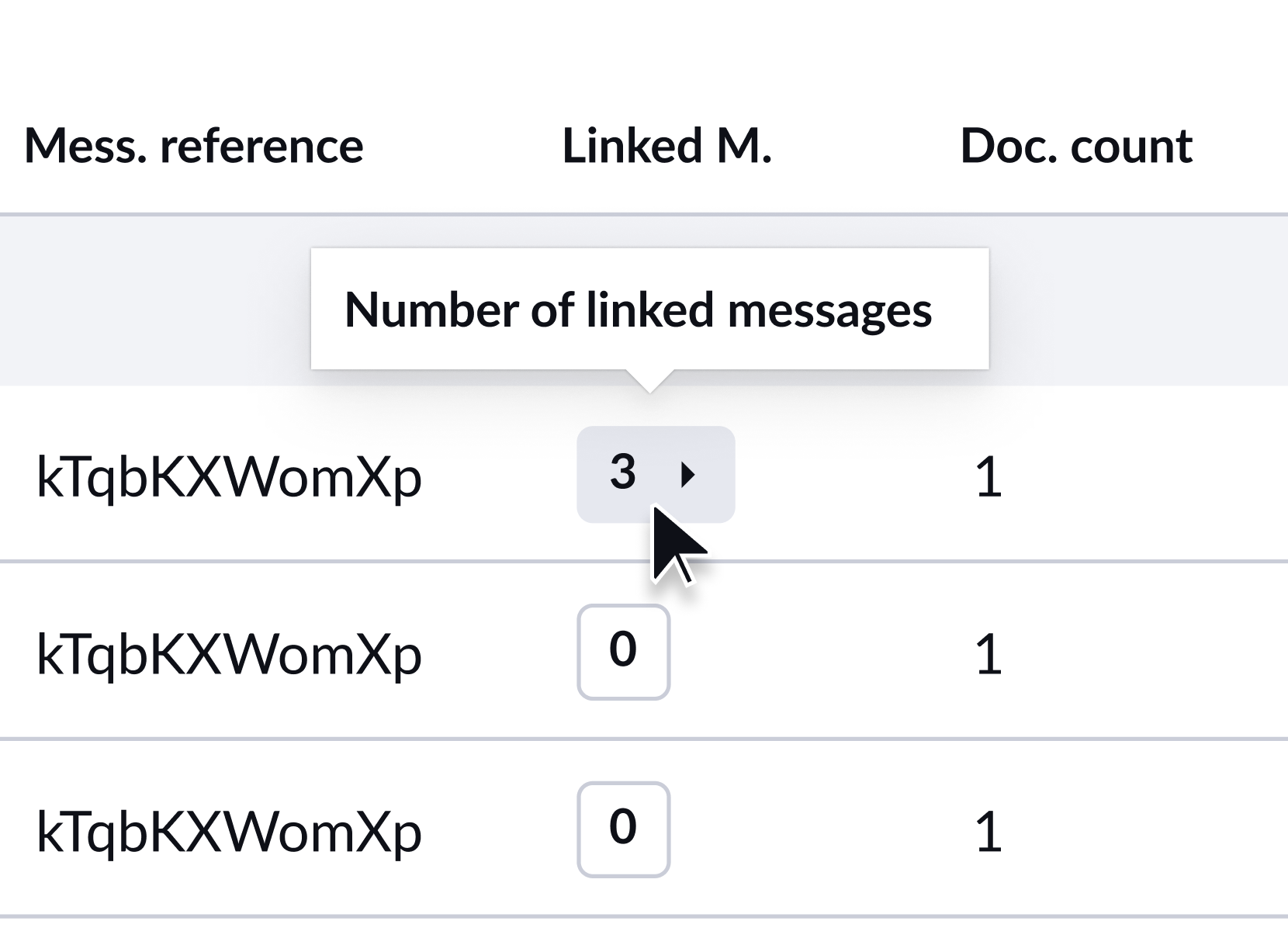
  • Spot connected messages instantly with a linked-messages count, shown up to 99+

  • Jump straight to the message you need, previewing up to five references on hover or opening the full list

  • Trust what you're looking at, with each reference tied to the ecosio Message ID and a tooltip to explain it

Break billing down by your own identifier - GLN and identifier filter on Statistics

Multi-entity customers could only split billing data by partner, not by their own identifiers, so reconciling by subsidiary usually ended up in Excel. Now you can filter Statistics by a single identifier such as GLN, Peppol participant ID or customer number, so your billing view lines up with how your business is actually structured. It's one of our most-requested Statistics improvements.

  • Reconcile by subsidiary, not just by partner, filtering by one identifier per query

  • Find the right identifier fast with free text or the alias dropdown, plus a tooltip showing what's searchable

  • Hand over clean numbers, with filtered report downloads matching your selection

Validate billable volumes to the exact hour - Date and time picker on Statistics billable messages

Statistics could only be filtered by preset ranges like this week, so checking billable volumes around a specific event, such as a go-live or a sudden spike, wasn't possible. Now you can narrow billable message statistics to an exact date and hour range and carry that straight into your export, so the numbers are easy to validate and defend.

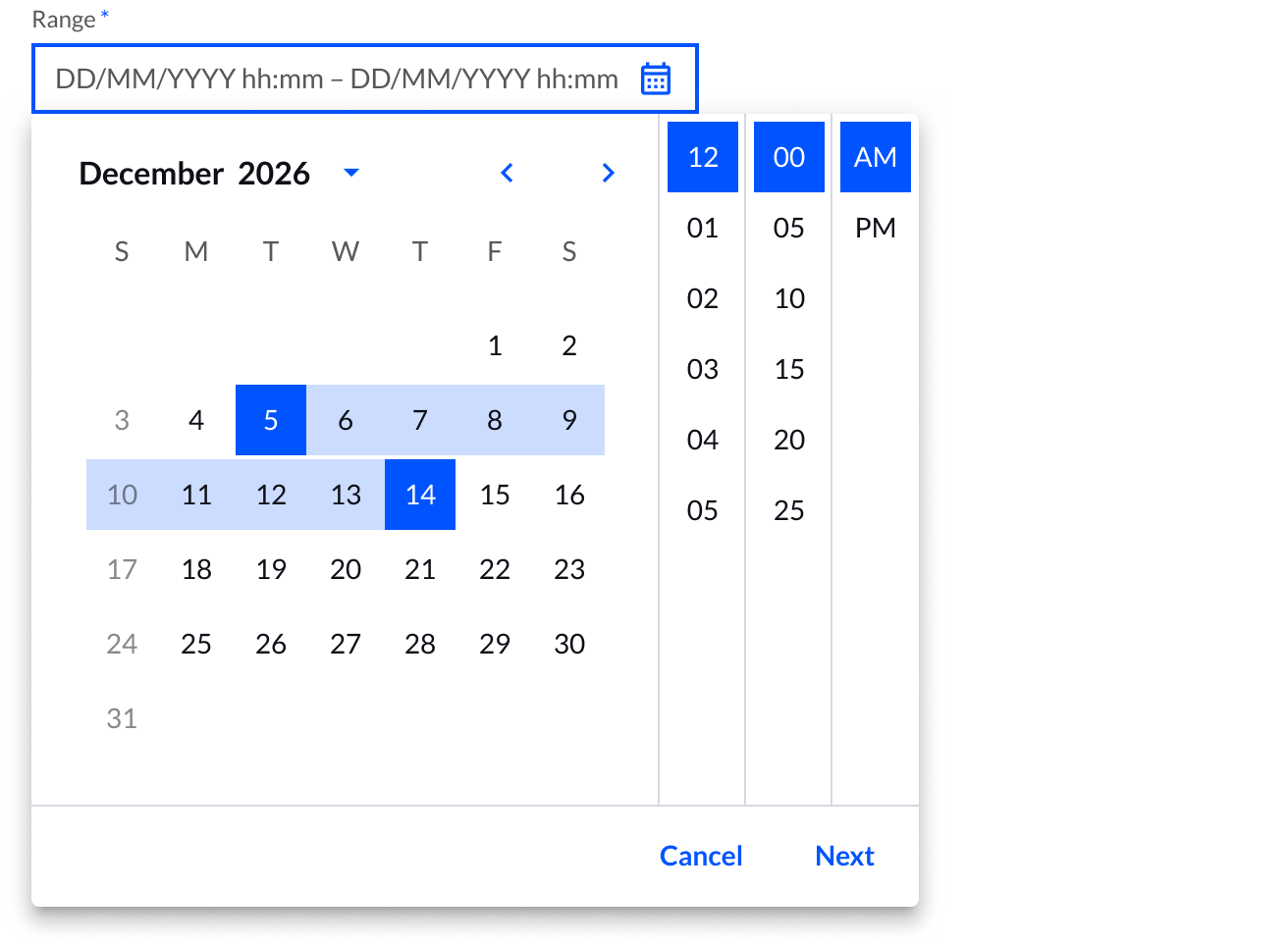
  • Check volumes around a specific event by picking an exact date and hour range

  • Match the source data, with filtering by full hours in line with how billable data is stored

  • Back up the figures, with your selection included in the CSV export

Pinpoint the exact time - Time picker on the Message Overview

Filtering the Message Overview by date alone meant paging through everything that happened that day to find a single message. Now you can filter to an exact time, down to the minute, so a time-critical investigation takes seconds instead of a scroll through hours of traffic. This came straight from your feedback.

  • Find the exact moment an issue happened, setting start and end times down to the minute

  • Cut investigation time from a full-day scroll to a few seconds

  • Keep the detail, with your selection included in CSV downloads

Technical notes

  • Some features depend on customer configuration, permissions or rollout status, so availability may vary by company and user

  • Linked messages show a count up to 99+, with up to five references on hover and the full list in the modal

  • The Statistics identifier filter works one identifier at a time

  • The Statistics date and time picker works by full hours, while the Message Overview time picker goes down to the minute

  • Linked message references use the internal ecosio Message ID, not your own message reference

Take a look in Monitor and tell us what you think🔥

The ecosio Product team

Write a comment...

August 5th, 2026

Connect Public Documentation

Public

China e-invoicing comes with country-specific steps that can slow teams down, and authentication is the first of them. Until your China connector is authenticated, it can't send or receive invoices. That step is now yours to complete in Monitor, whenever you are ready. We keep the connection to the tax authority running. You decide when to switch it on.

  • Activate your China connector yourself. A guided flow from start to finish, at your own pace.

  • Download the official OFD invoice. The cleared invoice exactly as the tax authority issued it, straight from the e-invoicing toolbox.

Activate your connector in one guided flow

It all happens on one screen. Enter your account details, request an SMS code to your registered phone number, enter the SMS code and then scan the QR code to complete facial recognition in the State Taxation Administration app. Confirm in Monitor, and your connector is active.

Click through the flow before you start:

The verification codes are time-limited, so if one runs out, or you step away before you're finished, you can start the flow again as often as you need.

Stay ahead of expiring Tax Agent IDs

Your Tax Agent IDs tell the tax authority which agent is authorised to invoice on your behalf, and they don't last forever. When one expires, sending and receiving stops for that Tax Agent.

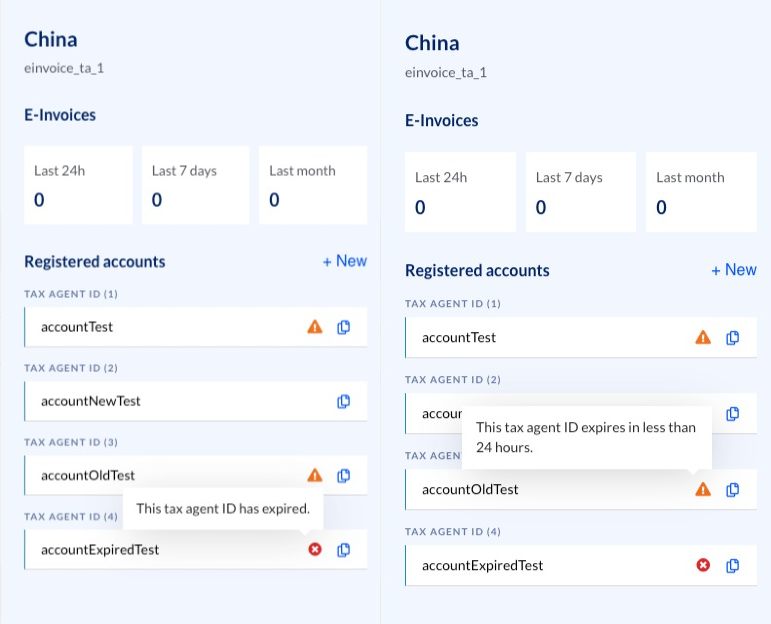
So Monitor keeps them in plain sight. Add as many Tax Agent IDs as your connector needs, see them all in the connector details, and get a warning as an expiry date approaches, while there's still time to act. The first ID you verify is what brings your connector to life.

Download the invoice the tax authority cleared

Whenever you need to prove an invoice really cleared, whether for an audit, a customer query or your own records, the proof is already in Monitor. Once an invoice reaches a cleared state, you can download the official OFD file straight from the e-invoicing toolbox, exactly as the tax authority issued it, carrying the invoice identifier, QR code and digital signature that prove it cleared.

OFD is China's official fixed layout format, the human-readable rendering of a cleared e-fapiao. It's similar in purpose to a PDF, but OFD is the format the Chinese ecosystem expects.


You activate your connector and manage your Tax Agent IDs, so you can be live in China sooner and stay live without interruptions. We keep the connection to the tax authority running and the rules behind it up to date, so the parts you handle stay simple.✨

Want to know more about self-service connectors, or have activation switched on for your Monitor? Get in touch with our team and we'll take it from there.

The ecosio Product team

Write a comment...

August 4th, 2026

Public

If you invoice Slovak buyers or public bodies, the rules are about to change. From 1 January 2027, Slovakia moves B2B and B2G onto the same decentralised Peppol five‑corner model, and the existing IS EFA portal for B2G is being decommissioned.

ecosio's Global E‑invoicing Compliance solution is production‑ready for Slovakia today, so you can prepare early instead of scrambling in Q4 2026.

What's changing in Slovakia

  • Invoices flow peer‑to‑peer between certified service providers, known locally as digital postmen, over Peppol BIS Billing 3.0 with the Slovak CIUS v1.8.

  • A separate invoice data document, known as the Slovak tax data document or SK TDD, must reach the Financial Administration within a 15‑minute window.

  • B2B and B2G follow the exact same rules from day one.

How Global E‑invoicing Compliance helps you get ready

  • Transforms your outbound invoices into Peppol BIS Billing 3.0 with the Slovak CIUS, so your team runs one mapping across standard and correction flows instead of maintaining country‑specific logic in your ERP system.

  • Generates and submits the SK TDD asynchronously inside the 15‑minute legal window, so you stay compliant without anyone watching a clock.

  • Connects you to the Slovak Peppol network as an accredited digital postman via the centralised Slovak SMP, so you don't have to build or certify delivery infrastructure yourself.

  • Handles message‑level status and exceptions in one dashboard, so AR and AP teams see exactly where an invoice is stuck and can fix it before it delays payment.

  • Covers national onboarding steps such as E‑faktúra registration on PFS, DIČ verification and digital postman selection, plus ten‑year compliant archiving, so audit readiness is built in from day one.

Why acting now matters

Slovakia's guidance is still evolving, and issuers who wait risk reactive rework, failed submissions, and VAT deductibility issues. Starting your rollout on a future‑proof platform means one integration covers Slovakia and every other mandate we support, so your next country launch does not start from scratch.

Ready to get started?

Explore the details and contact our team via the Slovakia country page: E-invoicing compliance in Slovakia.

The ecosio Product team

Write a comment...

July 28th, 2026

Public

Global E-invoicing Compliance now supports Singapore, so if your compliance deadline is already here or still ahead, you can get connected today without building anything from scratch.

Singapore's GST InvoiceNow mandate uses a five-corner model that creates two simultaneous obligations for every GST-relevant invoice: deliver it to your trading partner via Peppol, and submit a copy directly to IRAS via API. Only IMDA-accredited Access Points can handle that IRAS submission, and ecosio is accredited.

What we built for you

  • Dual delivery in a single flow: Peppol delivery and IRAS reporting run as coordinated steps in a single integration path, so you don't manage two separate connections.

  • Wide document support: Tax invoices, credit notes, debit notes, simplified tax invoices, and self-billed invoices.

  • PINT SG transformation and validation: We prepare your documents for Peppol InvoiceNow using PINT SG, then validate the IRAS copy against the IRAS Schematron before submission.

  • CorpPass activation support: We manage the authorisation workflow so ecosio can submit on your behalf.

  • Visibility in Monitor: You can track submission status, acknowledgement IDs, and error codes in one place, so you catch issues before they become penalties.

When you need to comply, we're ready

InvoiceNow rolls out from the bottom up, reaching every GST-registered business by 2031:

  • 1 April 2026: all new voluntary GST registrants

  • 1 April 2028: new compulsory registrants and existing businesses with annual supplies up to S$200,000

  • 1 April 2029: existing businesses with annual supplies up to S$1,000,000

  • 1 April 2030: existing businesses with annual supplies up to S$4,000,000

  • 1 April 2031: existing businesses with annual supplies above S$4,000,000

Connecting early means your setup is tested and stable before your deadline.

For the full mandate breakdown, visit our e-invoicing in Singapore page. Ready to get started? Talk to our team.

The ecosio Product team

Write a comment...

July 17th, 2026

Connect Public Documentation

France e-invoicing is moving from preparation to operational reality. From 1 September 2026, e-invoice reception becomes mandatory for all VAT-registered businesses in France, while issuance and e-reporting obligations begin for large and mid-sized companies.

For many teams, the challenge is not only sending and receiving compliant e-invoices. It is understanding what is happening to each invoice once it starts moving through the process, especially when several state journeys exist in parallel.

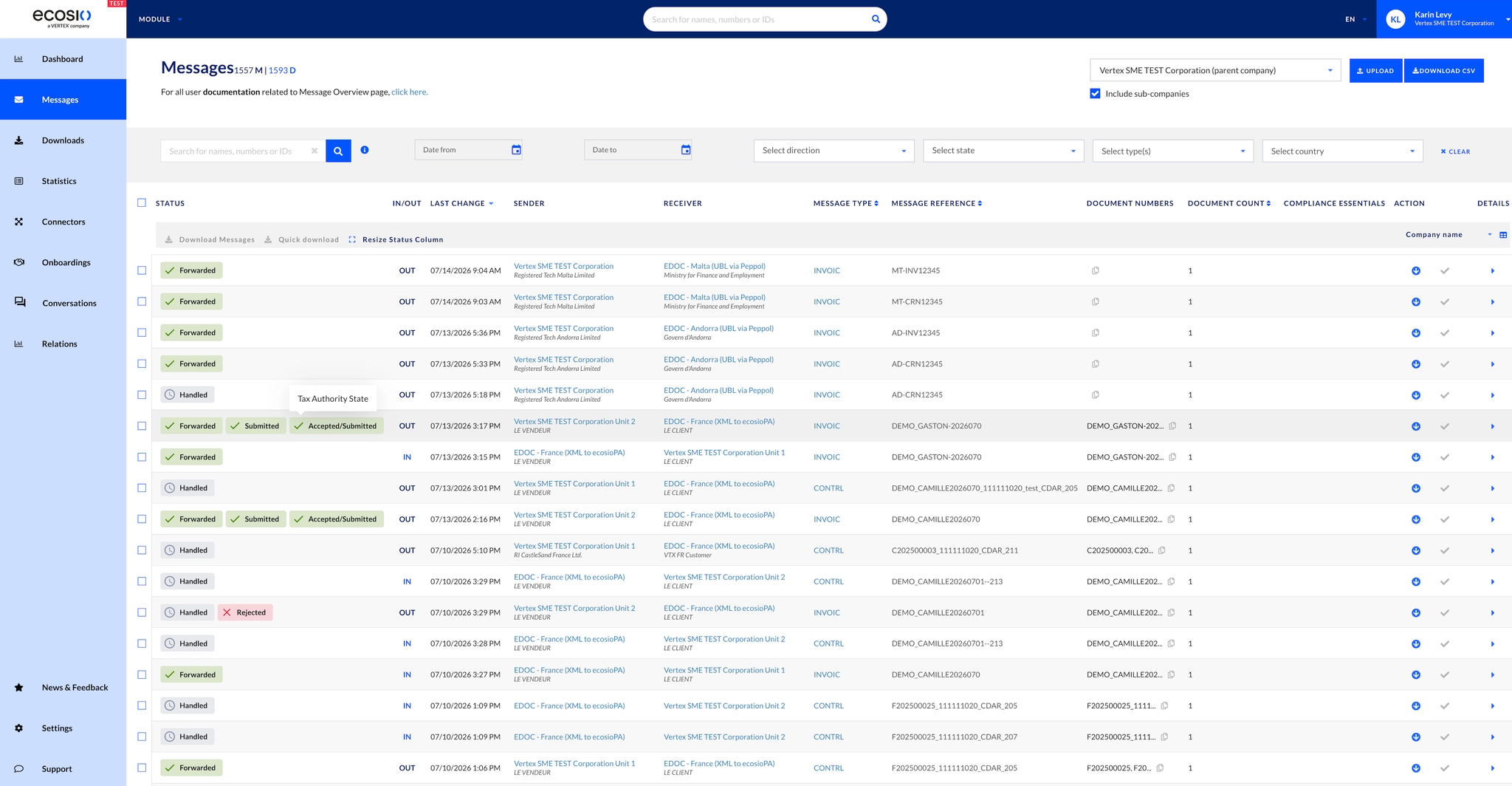
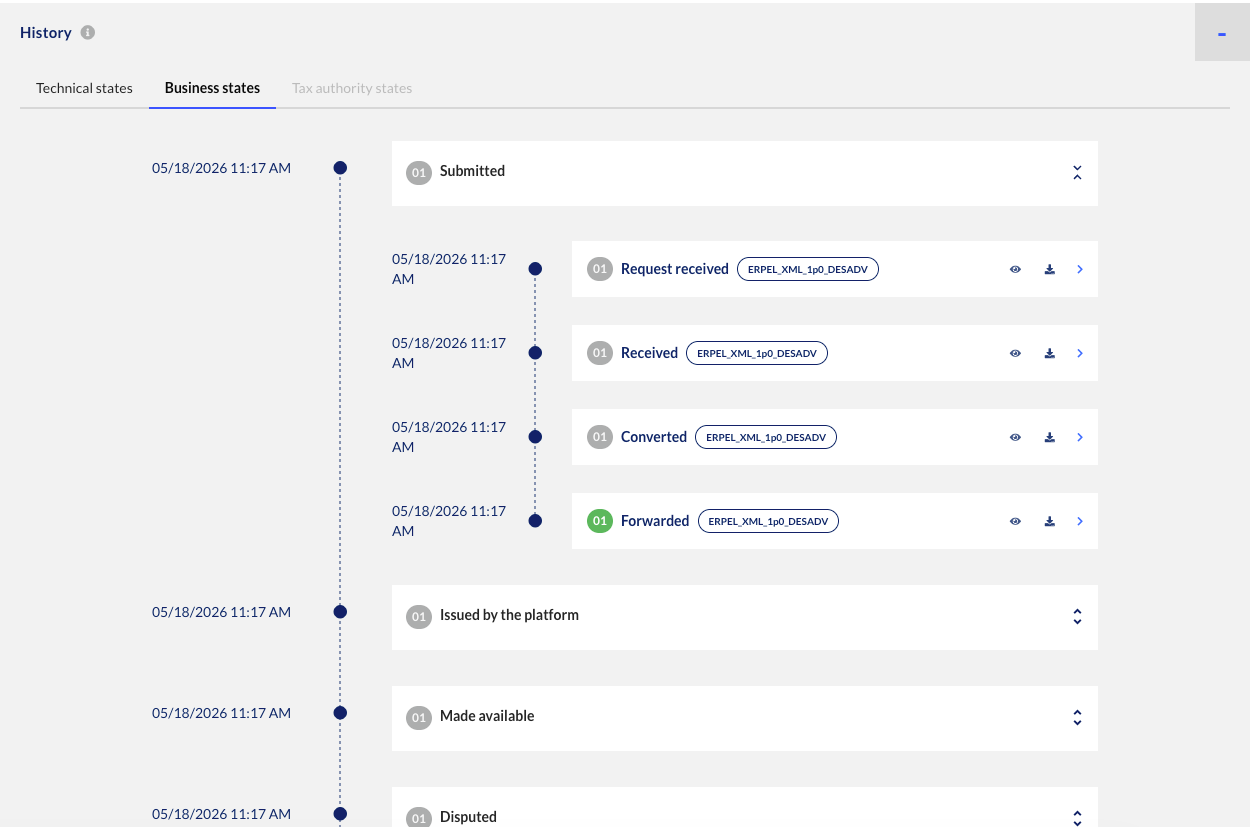
A single France invoice can have a technical state, a business state and a tax authority state, each showing a different part of the lifecycle. Without a clear view of these states, users can lose time trying to work out where an invoice stands, which part of the process needs attention and whether action is required.

That is why we’ve added three Monitor improvements that bring more transparency and actionability into one place. They help users understand France-related invoice journeys more easily, investigate the right timeline faster and take selected actions directly in Monitor.

See multiple states in the Message Overview

The Message Overview can now show multiple relevant states for a message in one place.

Instead of relying on one generic status, users can see technical, business and tax authority states separately. This makes it easier to understand whether an invoice is progressing as expected, waiting for a business lifecycle update or affected by a tax authority response.

This is especially useful for France e-invoicing, where one invoice can move through several parallel state journeys.

Follow the right timeline in Message Details

Message Details now include separate state history views for Technical, Business and Tax Authority states when multiple state types exist.

This helps users focus on the timeline that matters most without searching through mixed technical details. For example, users can confirm whether the technical processing was successful separately from a refused invoice or a rejected tax authority response.

The result is a cleaner investigation experience, faster issue understanding and less uncertainty when reviewing France-related transactions.

Update eligible inbound invoice states manually

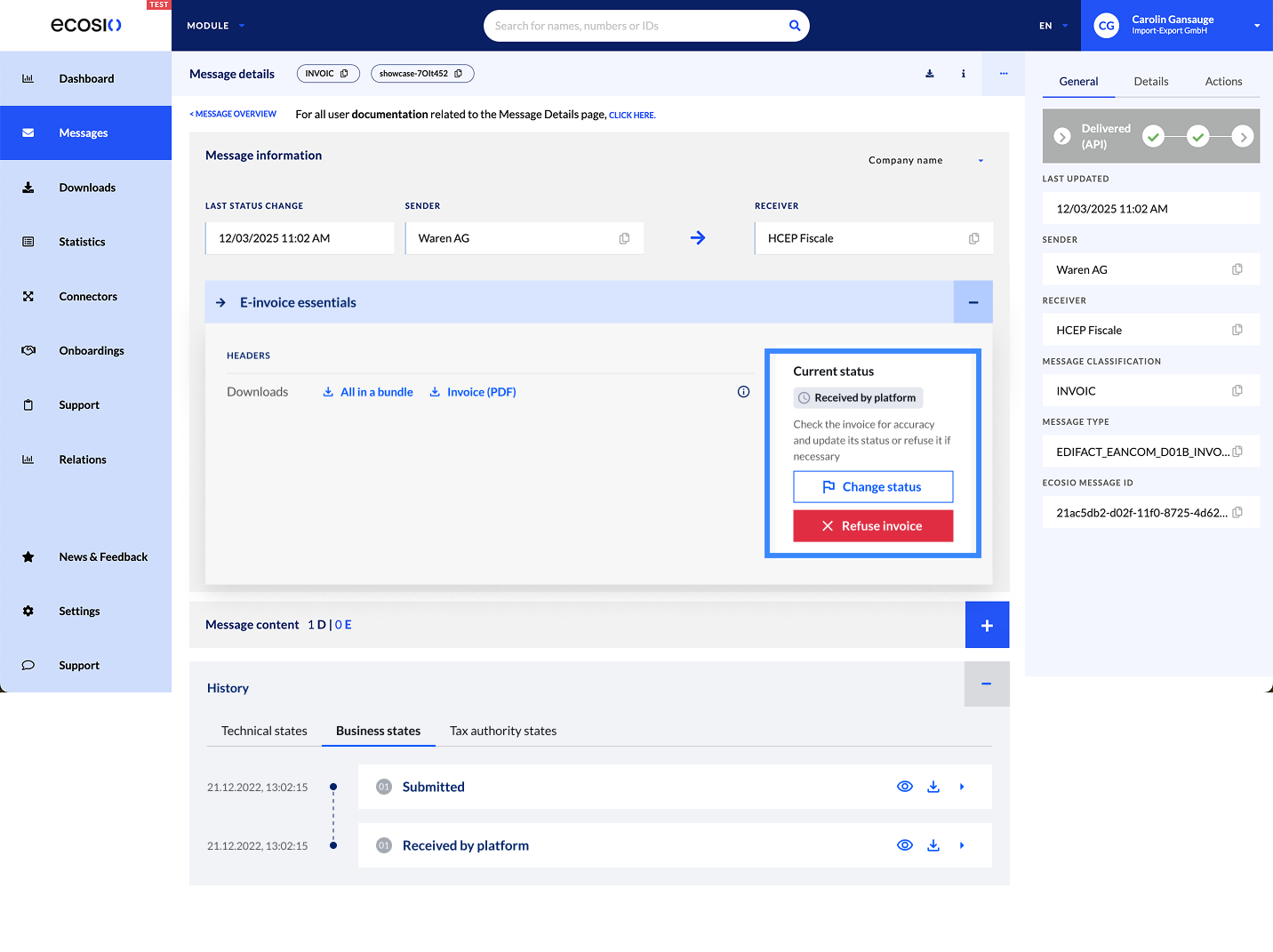
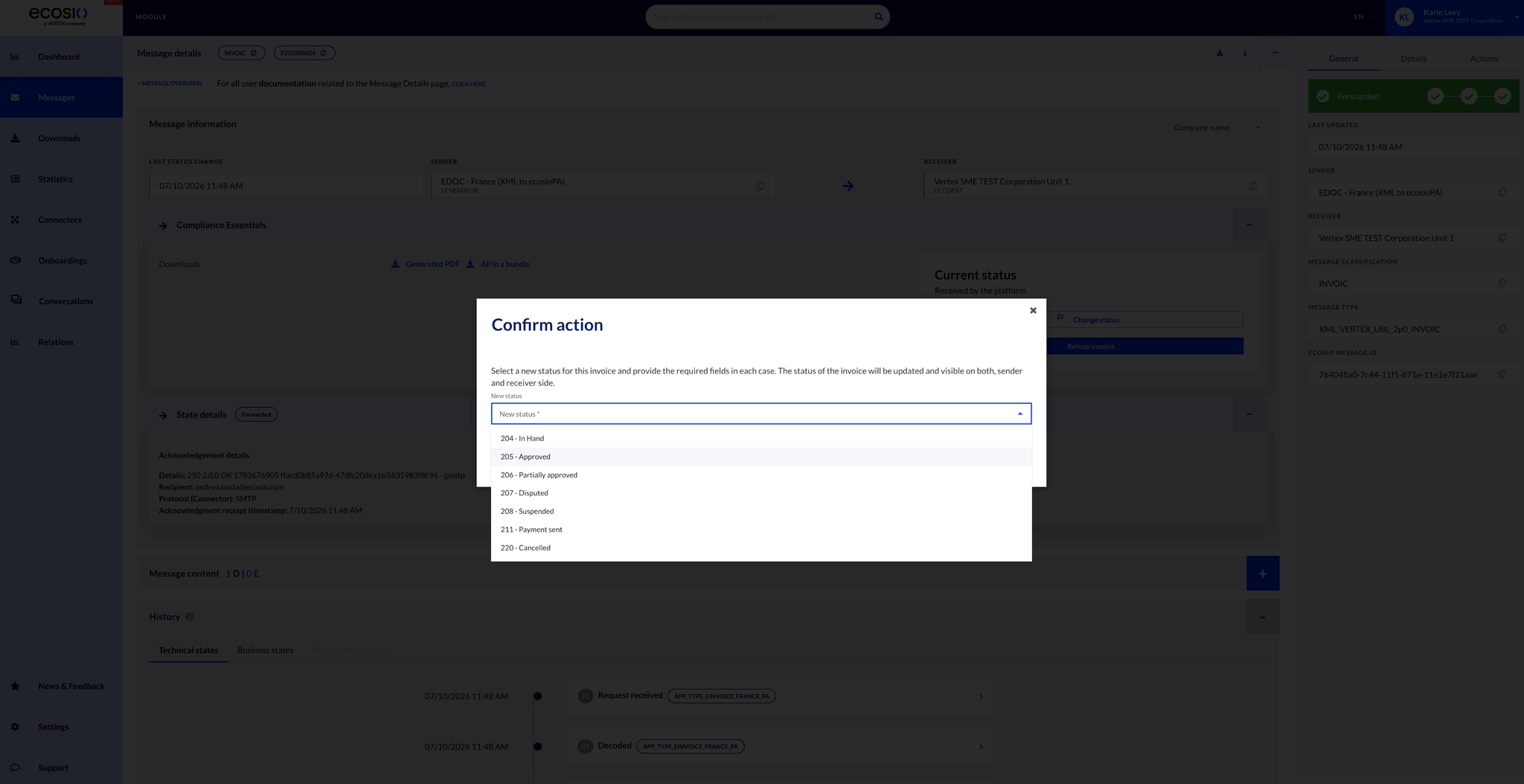
Sometimes understanding the state of an invoice is not enough. Teams also need a clear way to complete required business actions when an inbound France invoice needs to be updated or refused.

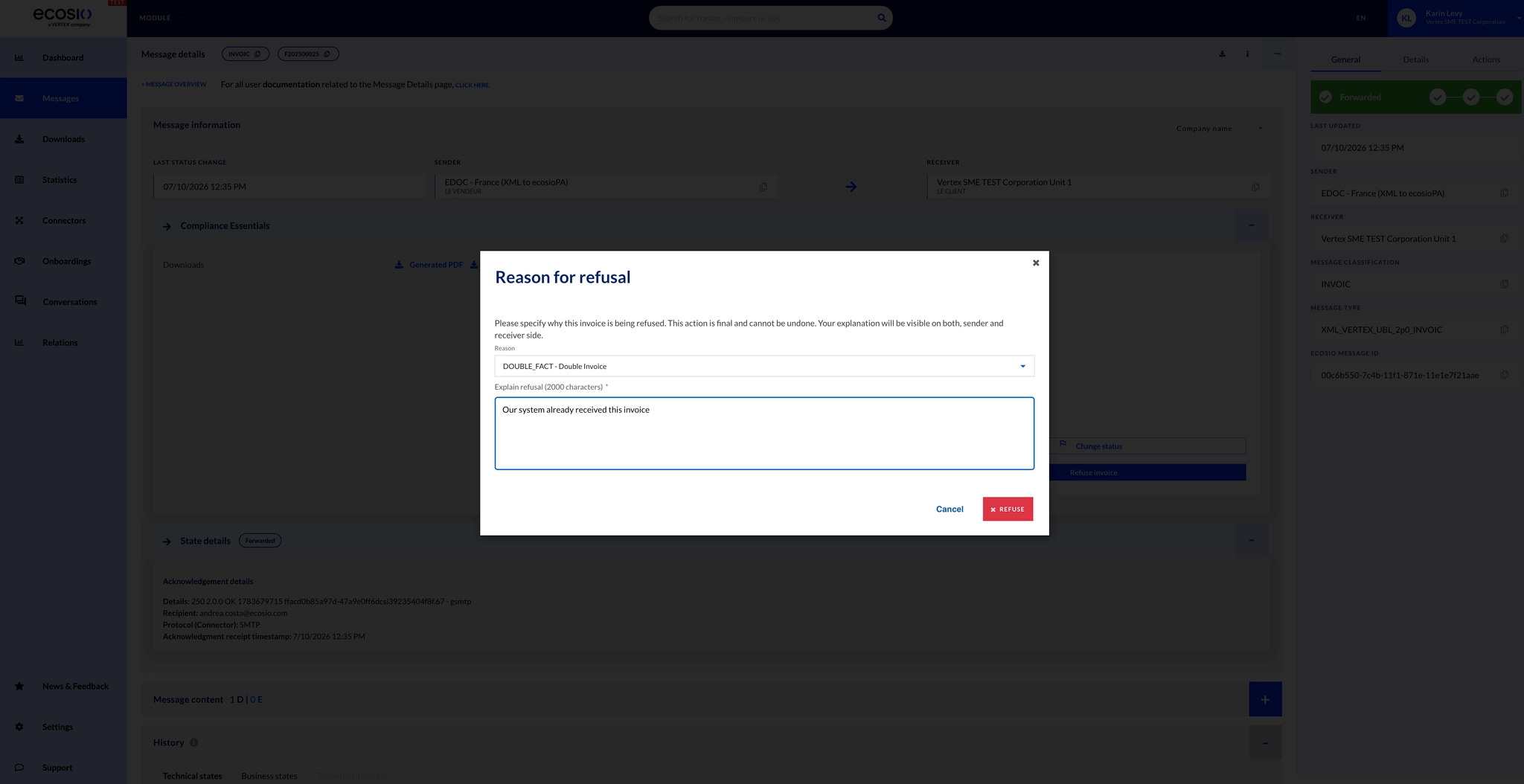
Users can now update the business state or refuse an invoice directly in Monitor. These actions are permission-controlled, and users can review the history of the changes directly in the relevant state history tabs. Refusals include an audit trail and are final, meaning they cannot be undone once submitted.

This gives teams a guided way to act in Monitor, while keeping the process transparent, controlled and easy to review.

Why this matters

France e-invoicing brings more operational complexity than a simple send-and-receive invoice flow. Teams need to understand technical processing, business lifecycle updates and tax authority responses clearly, especially as the September 2026 milestone approaches.

These Monitor updates help users:

  • see where an invoice stands across technical, business and tax authority states

  • understand which part of the journey needs attention

  • investigate the right state history without searching through mixed technical details

  • complete selected invoice actions directly in Monitor

  • review important changes in a transparent and auditable way

Together, these improvements make France e-invoicing easier to monitor, investigate and manage in day-to-day operations. They also give business users more autonomy by bringing transparency and actionability into the same workspace.

The ecosio Product team

Write a comment...

July 15th, 2026

Public

We are excited to announce that ecosio's Global E-invoicing Compliance solution is now live for China, enabling enterprises to issue and receive fully digitalised electronic invoices (e-fapiao) in line with the requirements of the State Taxation Administration (STA). Businesses operating in China can now onboard with ecosio and manage their end-to-end e-invoicing flows through a single, globally consistent platform.

With China's clearance-based model already mandatory for VAT-registered entities, this milestone gives multinationals a reliable path to compliance without the overhead of building or maintaining direct integrations with local tax authority systems.

What e-invoicing in China means for your business

China operates a clearance-based Continuous Transaction Controls (CTC) model, administered by the State Taxation Administration (STA) through the Golden Tax System (GTS). Since 1 December 2024, all taxpayers nationwide are authorised to issue fully digitalised e-fapiao, and paper and legacy invoice formats are being progressively phased out. Since 2025, e-fapiao is steadily becoming the standard VAT invoice format for B2B, B2G, and B2C transactions.

Because foreign entities cannot connect directly to the STA, and operational controls such as facial recognition authentication, red-letter corrections, and 10-year in-country archiving apply, running China e-invoicing at scale requires an integrated, compliance-ready approach.

How Global E-invoicing Compliance simplifies China e-invoicing

With Global E-invoicing Compliance, you can meet China's e-fapiao requirements without building or operating direct integrations with Chinese tax authority systems. Our solution provides:

  • STA-compliant clearance orchestration, transforming ERP data into compliant XML and managing submission, clearance, and retrieval of official artefacts (invoice number, QR code, digital signature, timestamp).

  • Compliant local connectivity covering authentication (including facial recognition), issuance, and archiving in line with STA rules.

  • Support for the full document scope, that is: Special VAT e-fapiao, General VAT e-fapiao, and red-letter (credit) invoices for corrections.

  • Operational visibility into invoice status, errors, and pending authentications through ecosio Monitor.

  • Global coverage, enabling you to manage China alongside every other country where you operate through one single platform.

Ready to connect?

Visit our China country page for detailed technical specifications, or contact our sales team today to start onboarding and ensure your business is fully compliant with China's e-fapiao requirements.

The ecosio Product team

Write a comment...

July 6th, 2026

Connect

Connect Public Documentation

🚀 What’s new

1. Peppol Scenario Support (multi-country)

Partners now have access to support for a set of Peppol-based scenarios that can be activated via the Management API.

Countries included:

  • Germany

  • Norway

  • Belgium

  • Sweden

  • Netherlands

  • Finland

  • Estonia

  • Denmark

Example: Peppol Belgium scenario payload

{ 
"name": "BELGIUM_EINVOICE", 
"peppolParticipantIds": "2090:BExxxxxxxxx", 
"emailAddressesForValidationErrors": "test@ecosio.com", 
"direction": "BOTH" 
} 

2. Test-only flag (usedForTestOnly)

We introduced the optional parameter usedForTestOnly = true to clearly mark entities created via the Management API as test data.

It can be applied to:

  • Companies

  • Connectors

  • Scenarios

🔍 Why is it important?

This flag helps separate testing activities from real customer configurations, so internal teams can quickly identify non-production objects and handle approvals, visibility, and reporting accordingly.

The ecosio Product team

Write a comment...

July 1st, 2026

Public

Slovakia e-invoicing reality is changing and businesses need to plan for it.

Today, Slovakia’s B2G e-invoicing framework is based on the centralised IS EFA (Informačný Systém Elektronickej Fakturácie), Slovakia’s current centralised platform for public sector invoicing.

However, from 1 January 2027, the current B2G model is expected to be replaced. Slovakia’s existing IS EFA framework is also expected to be decommissioned as part of the 2027 transition. From that point, B2G and B2B e-invoicing will follow the same Peppol based model, removing the technical distinction between public sector and private sector invoice exchange. Under this model, VAT-registered businesses established in Slovakia will need to issue, receive and exchange structured e-invoices through accredited service providers, with invoice data reported to the Slovak Financial Administration.

As ever, ecosio is fully preparing for this change and we have already kicked off our implementation for Slovakia. This is part of our broader effort to expand coverage across Europe and ensure our customers can rely on a single platform to manage compliance and business processes across multiple jurisdictions.

What you must know about Slovakia’s e-invoicing mandate

If your business operates in Slovakia, or sells to Slovak public entities, e-invoicing is moving from a public sector requirement to a broader day-to-day compliance obligation.

Here are the key points to understand:

  • The current B2G model is being replaced. Slovakia’s existing IS EFA framework is expected to be decommissioned as part of the 2027 transition. From that point, B2G and B2B e-invoicing will follow the same Peppol-based model, removing the technical distinction between public sector and private sector invoice exchange.

  • PDF invoices will no longer be enough for in-scope domestic transactions. From 1 January 2027, domestic B2B and B2G invoices in scope will need to be exchanged as structured electronic invoices. PDF invoices sent by email will not meet the new compliance requirements.

  • Invoices must be exchanged through accredited service providers. Slovakia’s new model is based on Peppol and requires businesses to work with an accredited service provider, locally referred to as a “Digital Postman”. This means businesses cannot simply connect directly to the tax authority or exchange invoices through informal channels.

  • Tax data reporting happens in parallel. In addition to exchanging the invoice through Peppol, the model introduces a Slovak Tax Data Document, or SK TDD. This document contains invoice-related tax data and must be submitted to the Slovak Financial Administration alongside the invoice process.

  • Timing requirements are strict. The Slovak model includes tight reporting timelines, including a 15-minute window for submitting the Tax Data Document in relevant scenarios. This makes automation, validation and reliable process monitoring especially important.

  • Customer onboarding will be an important operational step. Customers will need to register through the national onboarding process, provide key identity data such as their 10-digit Slovak Tax Identification Number, or DIČ, and select their accredited service provider before compliant invoice exchange can be enabled.

The risk of underestimating Slovakia is simple: if the structured invoice data, delivery mechanism, reporting process or onboarding setup is wrong, businesses can face avoidable rework, delayed payments and increased compliance exposure.

That is why ecosio’s Global E-invoicing Compliance is built for multi-country reality. Through one integration, ecosio helps businesses manage e-invoice creation, validation, routing, monitoring and compliance handling across jurisdictions. For Slovakia, this helps reduce the effort of managing local requirements while keeping processes consistent, automated and audit-ready.

Timeline

  • April 2023: IS EFA fully operational — B2G mandatory.

  • 2026: The e-invoicing legislation became legally valid, opening the way for the pilot and voluntary phase. Digital Postman accredited providers list published, businesses must select one for B2B compliance

  • 1 January 2027: Mandatory structured e-invoicing and automatic reporting are expected for domestic B2B and B2G transactions involving VAT-registered businesses established in Slovakia.

  • 1 July 2030: The mandate is expected to expand to intra-EU cross-border transactions, aligning with the ViDA timeline.

If you do business in Slovakia, or plan to, now is the time to assess whether your transactions fall within the January 2027 mandate. Get in touch to get a customised path to compliance based on your business needs. Or subscribe to our e-invoicing deadlines calendar to never miss any new mandate.

The ecosio Product team

Write a comment...

April 27th, 2026

Public

Spain is moving toward mandatory B2B e-invoicing, with the proposed deadline expected in October 2027. While the legislation is still in draft, businesses operating in Spain are already navigating a multi-layered compliance landscape.

With Global E-invoicing Compliance, we are building out Spain support so your business can meet the upcoming requirements without adding new portals or separate integrations.

What makes Spain complex

Spain's e-invoicing framework has evolved over more than a decade, and not every obligation is at the same stage yet. Some requirements are already in force, while others are still planned or in draft. Besides the upcoming mandate affecting B2B e-invoicing, we also have:

  • B2G e-invoicing: Public sector e-invoicing via FACE using the Facturae format has been mandatory since 2015 and remains in place.

  • SII reporting: The SII system already applies to large taxpayers and requires near-real-time VAT reporting.

  • Verifactu: This anti-fraud invoicing-software requirement is a separate obligation and is expected to apply from 2027.

  • Other regional requirements: Additional regional obligations may still apply depending on where a business operates.

How Global E-invoicing Compliance helps

Managing Spain's overlapping mandates (different formats, platforms, and reporting obligations) creates real overhead for internal teams. GEC is designed to handle that complexity centrally:

  • Multi-format support: We cover the full range of EN16931-compliant formats required in Spain, so invoices reach their destination correctly regardless of which platform your trading partner uses.

  • E-signature handling: Digital signatures might be included in scope for B2B e-invoicing. ecosio is ready to apply them automatically where required for platform-to-platform exchange.

  • Unified flows for B2B and B2G e-invoicing: Whether you are invoicing government entities via FACE or exchanging B2B invoices across platforms, everything runs through a single integration.

Start preparing now

Our piece advice? Don’t wait until next year. Visit our Spain e-invoicing page for a full regulatory overview, or contact our sales team to get started.

The ecosio Product team

Write a comment...